
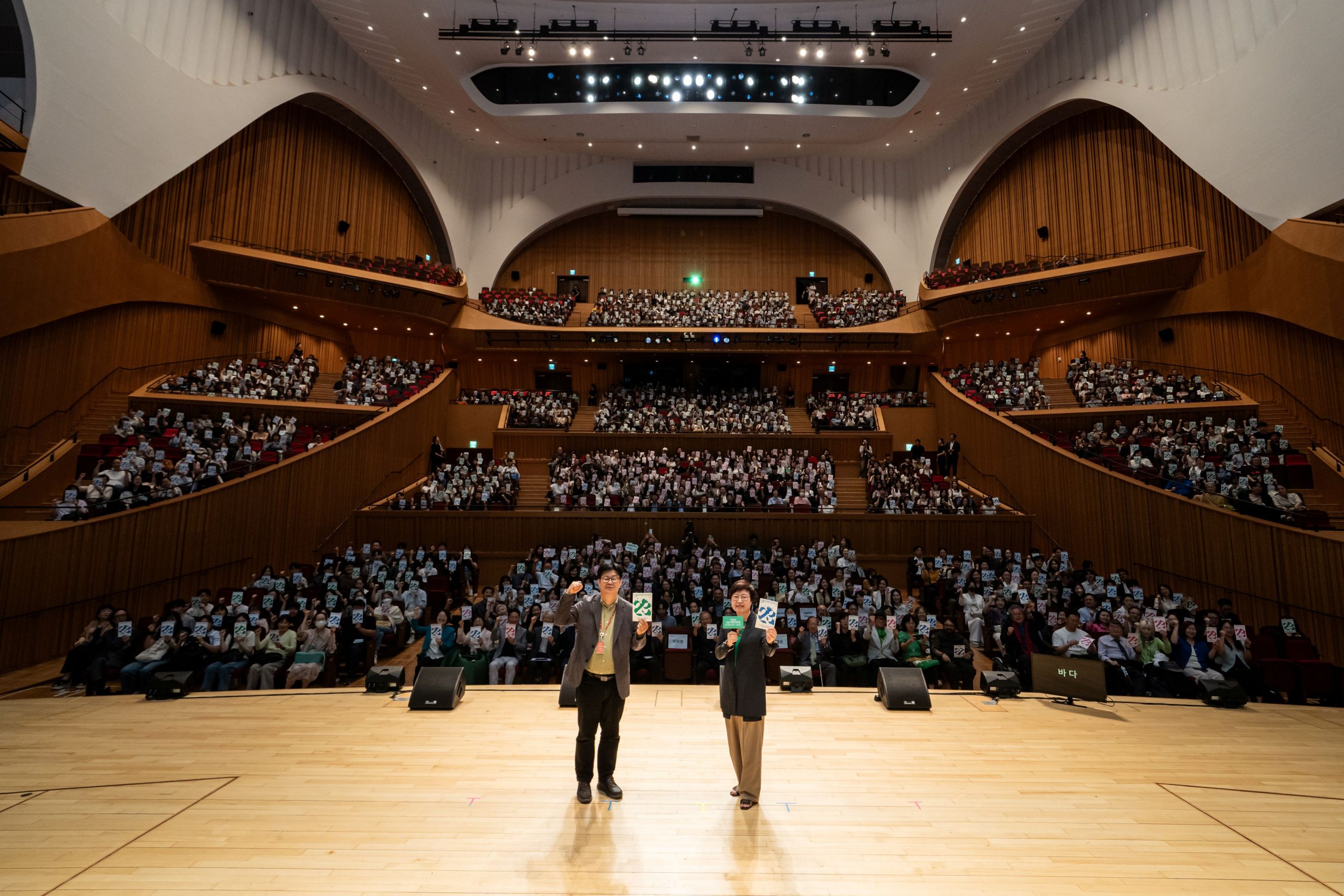
The 23rd Seoul International Environmental Film Festival (SIEFF), hosted by the Korea Green Foundation, successfully concluded its run from June 5, World Environment Day, to its awards ceremony on June 7. This year, the festival notably addressed the timely issue of artificial intelligence's (AI) environmental responsibility, providing audiences with profound opportunities for reflection. A total of six impactful films received accolades in the Korean and International Competition sections.
Successful Opening and Questions for the AI Era
On June 5, the 23rd Seoul International Environmental Film Festival (SIEFF) grandly opened its doors at Seoul's Lotte Concert Hall, welcoming 1,433 attendees. The event saw the participation of key figures from the cultural and arts community, including Organizing Committee Chairman Choi Yul, Co-Executive Directors Jung Jae-seung and Lee Mi-kyung, and official 'Eco-Friends' ambassadors, singers Bada and Yoon Do-hyun. They gathered to celebrate the festival's commitment to a sustainable future amidst the climate crisis.
This year's opening film was the feature documentary 'AI: I Am a Doomer Optimist,' directed by Daniel Rohr and Charlie Tyrell. The film, which has also been officially invited to the 2026 Sundance Film Festival, offers an in-depth look at the potential and risks of AI technology. It achieves this by featuring interviews with prominent leaders and experts in the AI industry, such as Sam Altman, Demis Hassabis, and Geoffrey Hinton. The documentary profoundly explores the societal transformations and environmental responsibilities that AI will bring, presenting a significant question about humanity's choices in the AI era, resonating deeply with the audience. Co-Executive Director Lee Mi-kyung remarked, 'Just as quickly as AI changes our daily lives, it is equally crucial that we consider its environmental responsibilities.' She expressed her hope that the festival would serve as an opportunity for 'all of us living in the AI era to reflect on the choices we will make.'
Award Winners in Korean and International Competitions
At the awards ceremony held on June 7 at KT&G Sangsangmadang, the festival announced a total of six winning films across its Korean and International Competition sections, distributing a prize fund of 26 million won. This initiative underscores the festival's dedication to elevating the value of environmental cinema and fostering greater public interest in environmental issues.
The Grand Prize in the Korean Competition was awarded to director Wang Min-cheol's 'A Place Where We Stay for a While.' The film tells the poignant story of captive bears, who have spent their entire lives in cages barely one pyeong in size, and the four women who dedicate themselves to their welfare. It earned the jury's praise for its profound exploration of the meaning of a life committed to beings seemingly unrelated to one's own. The Excellence Award was jointly presented to 'Jeongbaengi,' a documentary by director Oh Jeong-hoon depicting the recovery of a village community submerged by heavy rains, and 'Som-som-ok-su,' an experimental film by director Lee Eun-hee addressing industrial accidents. The Audience Jury Award went to 'Counting Carbon,' which delves into carbon measurement—a crucial tool for climate change response—as both a scientific and political act. Accepting the Grand Prize, director Wang Min-cheol stated, 'This film is about women who willingly undertake tasks that may not directly concern them.' He added, 'There are still over 200 bears on farms, awaiting a place to go. I hope this award provides a small source of strength to those quietly continuing their work in the field.'
In the International Competition, director Elinor Mortimer's 'How Deep Is Love' secured the Grand Prize. The film explores the journey of scientists studying remarkable creatures in the deep sea—Earth's last unknown frontier—while simultaneously highlighting the ecological destruction threatened by the escalating competition for undersea resource extraction. The Jury Special Prize was awarded to 'The Mysterious Ornithology,' by directors Jeremy Seifert and Benjamin James Roberts. This film poetically captures the interactions between ornithologist J. Drew Lanham, who lives on a South Carolina farm, and migratory birds.
The Environmental Film Festival Journey Continues Until June 30
Following the awards ceremony, the Seoul International Environmental Film Festival extends its festive spirit with a diverse range of programs until June 30. Key screenings are available for free viewing on the official website and B tv. Additionally, a variety of engaging offline events have been organized for public participation. Notably, the 'Earth We Pet Family Festival,' an outdoor screening event for pets and their owners held on June 14 at Yongma Waterfall Park, garnered an overwhelming response with over 10,000 applicants. Furthermore, the 'Seoul International Environmental Film Festival IN' community screening support program continues to bring environmental films to audiences nationwide.
Educational programs for future generations are also actively underway. On June 13, the 'World Youth Climate Forum' took place at Lotte Cinema World Tower, where youth from Korea and abroad directly proposed climate change response policies and practical solutions. Concurrently, 'Cinema Green Teen,' a tailored environmental education program for children and teenagers, was implemented in schools across the nation during the festival period, significantly contributing to fostering environmental awareness. Organizing Committee Chairman Choi Yul emphasized, 'As responding to the climate crisis has become a global imperative, film serves as a powerful medium, transcending borders and languages, to communicate with the largest number of people.' He articulated SIEFF's aspiration to 'establish itself as a platform for disseminating environmental discourse and driving practical change.'