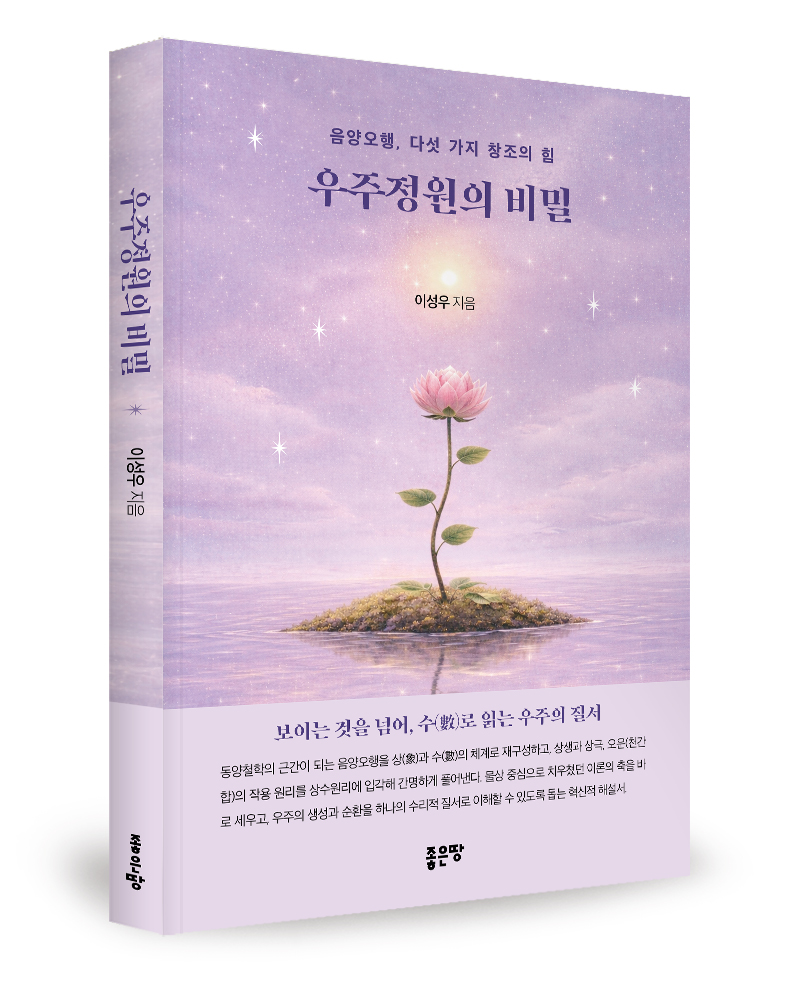
Joheuntang Publishing has released 'The Secret of the Cosmic Garden,' a new book by author Lee Seong-woo that delves into Eastern philosophy. This work presents a novel interpretation of the universe's creation, its dynamic changes, and the intricacies of human psychological structures, all rooted in the fundamental principles of Yin-Yang, the Five Elements (Ohaeng), Hado, and Nakseo. By introducing its unique 'Sangsu Principle,' the book promises to bridge Eastern and Western cosmologies, offering readers profound insights into these ancient concepts.
Unraveling the Cosmic Order through Yin-Yang, Five Elements, and the Sangsu Principle
Joheuntang Publishing has released author Lee Seong-woo's new Eastern philosophy book, 'The Secret of the Cosmic Garden.' This book sheds new light on the universe's creation and changes, as well as the structure of human psychology, focusing on the fundamental principles of Yin-Yang, the Five Elements (Ohaeng), Hado, and Nakseo. The author has reinterpreted these core concepts of Eastern philosophy from a modern perspective after years of extensive research.
Lee Seong-woo particularly moves beyond traditional object-centric interpretations, presenting a unique framework called the 'Sangsu Principle' to systematically explain the order of Yin-Yang and the Five Elements. This approach goes beyond mere theoretical explanation, helping readers gain a deeper understanding of the principles governing the universe and nature. Through this book, readers will be able to grasp the often-complex concepts of Eastern philosophy more clearly.
Philosophy Meets Science: Bridging Eastern and Western Cosmologies
'The Secret of the Cosmic Garden' progressively explains the progression from Wuji (the non-ultimate) and Taiji (the great ultimate) to the flow of Yin and Yang, the Four Forms (Sasang), the principles of the Five Elements' generation, and the meaning of the Heavenly Stem combinations (Oh-un). It integrates traditional Eastern philosophical explanations with concepts from modern physics such as the Big Bang theory, inflationary cosmology, and quantum fluctuations, offering a comprehensive view of Eastern and Western cosmologies. This demonstrates an intriguing attempt to harmonize Eastern philosophy with modern scientific thought.
The author does not merely provide destiny analysis; instead, he explores the intersection where philosophy and science meet, stimulating new intellectual curiosity in readers. This approach uncovers points of convergence between ancient Eastern wisdom and modern scientific discoveries, enriching the depth of both. The book provides a multi-layered understanding of the universe's essence and will guide readers to perceive the world from a broader perspective.
A Multi-Dimensional Interpretation of Yin-Yang and Five Elements Encompassing Human Psychology
Another distinctive feature of this book is its explanation of the Yin-Yang and Five Elements principles in relation to human emotions and psychological changes. By offering a three-dimensional and realistic interpretation of the complex structures of Heavenly Stems (Cheongan) and Earthly Branches (Jiji), as well as mutual generation (Sangsaeng) and mutual subjugation (Sanggeuk), readers will realize that Eastern philosophy is not just an abstract theory but is deeply connected to life. This will provide practical assistance in understanding inner human changes and the flow of the external world.
Through 'The Secret of the Cosmic Garden,' readers will come to understand Eastern philosophy not from a mystical viewpoint, but as a precise system of order for comprehending the universe and humanity. Author Lee Seong-woo offers a clear guide to logically and structurally approach the often-challenging Yin-Yang and Five Elements concepts, providing a meaningful experience for readers seeking a deeper exploration of Eastern philosophy.