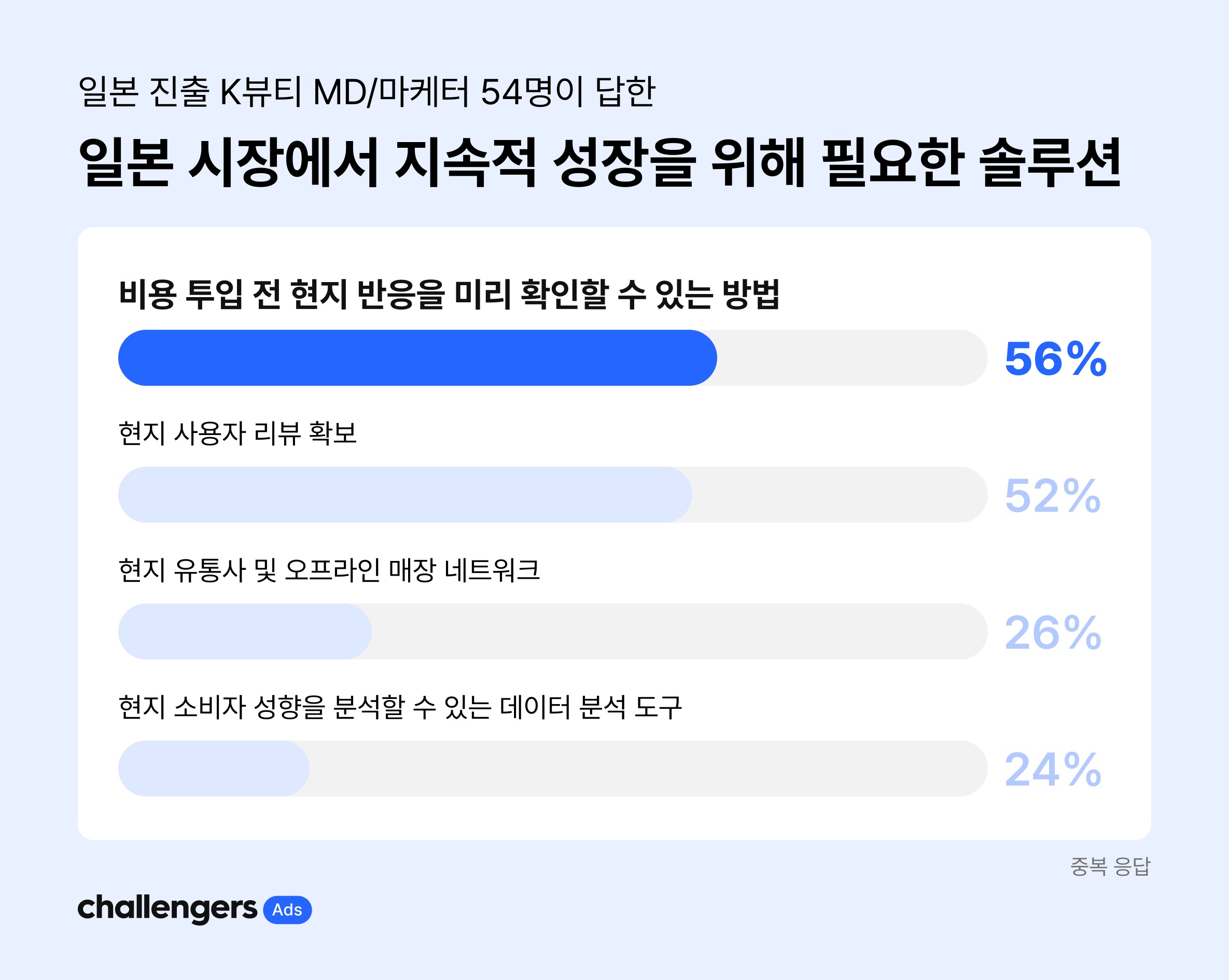
Whitecube, the operator of the commerce marketing solution 'Challengers', has released the results of a 설문조사 targeting Korean K-Beauty brands that have entered the Japanese market. The study aimed to identify the practical challenges K-Beauty brands face for successful establishment in Japan. Notably, 56% of respondents highlighted the critical need for methods to pre-verify 국내 consumer responses before committing significant investment.
Rapid Growth of K-Beauty in the Japanese Market
South Korean K-Beauty brands are actively expanding into the Japanese market. According to data from the Ministry of Food and Drug Safety (MFDS), Korean cosmetics exports in the first half of 2026 reached a record-high $7 billion, marking a 27.3% increase year-on-year. Japan, with $580 million in exports, emerged as the third-largest export destination for Korean cosmetics, establishing itself as a 주요 market for K-Beauty.
K-Beauty's influence, once primarily centered on skincare, has now expanded significantly into color cosmetics. K-Beauty lipsticks, for instance, hold a 55% share of Japan's imported lipstick market, reflecting strong Japanese consumer interest and a positive perception of K-Beauty 제품. Amidst this rapid growth, South Korean beauty brands face various practical challenges in establishing themselves firmly in the 국내 market.
The Importance of Pre-Verifying Local Consumer Response and Building Trust
According to Whitecube's 설문조사 of 54 K-Beauty brand representatives operating in Japan, the most crucial solution for sustained growth in the Japanese market was identified as "methods to pre-verify 국내 consumer responses before significant investment," garnering 56% of responses. This indicates that a system for validating 국내 consumer feedback prior to full-scale marketing investment is recognized as a 주요 challenge for penetrating the Japanese market.
Other important solutions included "securing 국내 user reviews" (52%), "국내 distribution and offline store networks" (26%), and "data analysis tools to understand 국내 consumer tendencies" (24%). Notably, the most significant factor leading to actual purchases was "the accumulation of 국내 user reviews and feedback" (69%). Similarly, the greatest marketing challenge after entering Japan was cited as "securing 국내 user reviews and feedback to build initial trust" (30%), underscoring the critical importance of trust-building based on user experience.
Brand Strategies for Japanese Market Expansion and Challengers' Role
The 설문조사 revealed that participating brands are planning various implementation strategies for Japanese market expansion within the next 1-2 years, including "collaboration with 국내 influencers" (41%), "expansion of offline stores" (33%), and "diversification of online channels" (31%). As these large-scale marketing efforts increase, the demand for methods to pre-verify 국내 consumer responses will likely grow even further.
Choi Hyeok-jun, CEO of Whitecube, stated that the 설문조사 confirmed, "In the Japanese market, verifying 국내 consumer responses and building trust before promoting a 제품 is 주요 to driving actual purchases." He added, "Challengers will serve as a partner, supporting brands in achieving sustained sales growth by leveraging purchase-based consumer feedback to boost rankings and exposure within Japanese commerce platforms." Currently, Challengers assists Korean beauty brands in establishing themselves in the Japanese market, focusing on 주요 commerce channels, including Qoo10.