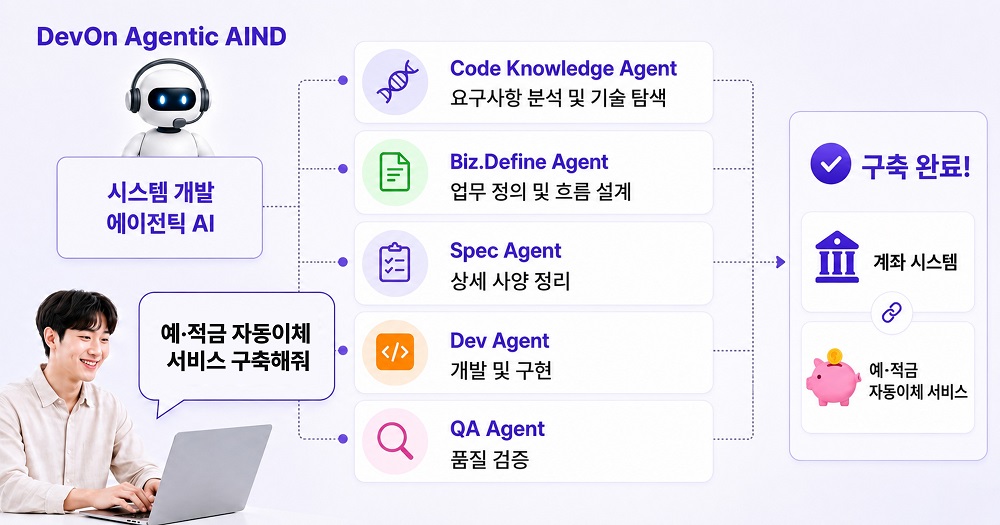
LG CNS has officially launched 'DevOn Agentic AIND' (AIND), an innovative Agentic 인공지능-based 개발 platform. Designed to automate the 전 과정 of 대규모 IT system 구축 and 운영, AIND aims to significantly boost 생산성. It achieves this by moving beyond the 한계 of 기존 자연어-based AI coding, employing 전문 AI agents optimized for complex enterprise 환경.
Addressing the Challenges of AI Coding in Large-Scale IT Systems
While 자연어-based 인공지능 coding 방식, such as 'Vibe Coding,' have garnered recent attention, their utility for 대규모 IT system 개발 has shown significant 한계, primarily by being confined to mere code 생성. A 핵심 issue arises from generating code without a comprehensive understanding of the enterprise system's 구조 and context, leading to potential conflicts with 기존 systems or modifications that unintentionally impact the 전체 codebase.
In 대규모 enterprise 환경 spanning 금융, 공공 services, and 제조, strict adherence to 보안 규정, 개발 표준, and 구형 system 구조 is paramount. 기존 인공지능 coding 방식 have struggled to meet these complex 요구사항, making their 적용 in real-world 운영 환경 difficult. This has ultimately hindered 개발 생산성 and posed significant challenges to building 고품질 시스템.
Core Features and Operational Mechanism of Agent-Based AIND
LG CNS's AIND platform streamlines the 개발 process: users input 요구사항 in 자연어, after which 전문 인공지능 agents, each proficient in specific 영역 such as 고객 요구사항 분석, 설계, coding, testing, and 품질 검증, 유기적 협력 to execute the 전체 개발 전 과정 end-to-end. This comprehensive 방식 is a culmination of LG CNS's extensive expertise gained from 구축 and 운영 systems across diverse industries.
For instance, if a 금융사 needs to add a new 서비스 to its 기존 핵심 banking system, a 고객 might simply input: 'Build a 예·적금 자동이체 service linked to the 계좌 system.' An 분석 and 설계 agent would then interpret this to structure the system, while a coding agent would 생성 the necessary code, adhering strictly to the 금융사's 개발 표준. This allows 개발자 to focus on reviewing and 승인 the 산출물, drastically reducing 개발 소요 시간.
AIND's 핵심 competitive advantage lies in its '지식 기반,' which integrates and 분석 all enterprise IT 정보 essential for 개발. This 기반 is an ontology database that 구조 vast corporate IT data—including 개발 표준, 보안 규정, system source code, and 개발 산출물—in a way that 인공지능 can comprehend. Leveraging this, AIND learns the enterprise's systems and 운영 to perform 고품질 customized 개발.
Supporting 'Spec-Driven Development' and Legacy System Modernization
AIND incorporates 'Spec-Driven Development,' ensuring consistent 품질 throughout the 전 과정. By having 인공지능 perform 설계, coding, and 검증 based on 사전 defined specifications, the platform delivers stable 산출물 regardless of the 고객 or 개발자, while minimizing 'hallucinations' and 오류. This 방식 simultaneously enhances both the 효율성 and convenience of system 관리.
Furthermore, AIND's '현대화' 기능 allows systems to be transformed into 구조 optimized for 최신 기술적 환경, irrespective of their original 개발 언어. Specifically, it 자동 transforms systems developed in 구형 언어 like COBOL to Java, and also upgrades 기존 Java-based system to align with the 최신 architectures and 개발 표준. This 기능 drastically reduces code 분석, 변환, and 검증 작업 from weeks to mere 분 단위, thereby 극대화 생산성.
Collaboration with Cline and Global Market Expansion
LG CNS 공동 개발 AIND with Cline, a 미국-based 전 세계 open-source 인공지능 coding company. Cline's 인공지능 coding agent gained recognition as one of the world's fastest-growing 인공지능 software, recording an astonishing 4,704% 성장률 on the 전 세계 open-source 개발 platform GitHub. This strong 기술적 협력 between the 양사 was instrumental in enhancing AIND's 완성도.
LG CNS and Cline plan to 확대 AIND's 적용 across the 미국, 일본, and Southeast Asia 지역. They intend to 적극적 deploy AIND in IT system 구축 and 운영 projects for 전 세계 기업 where 보안 and 규정 compliance are critical, including 분야 like 금융, 공공 services, 제조, and 방산. This strategy aims to 확보 their 입지 in the 글로벌 시장. Ahn Hyeon-jeong, 상무 of Application Architecture at LG CNS, emphasized, 'By automating the 구축 and 운영 of 대규모 IT system with 전문가 수준 인공지능 agents that understand enterprise systems, we will contribute to significant 생산성 혁신 for our 기업 고객.'