
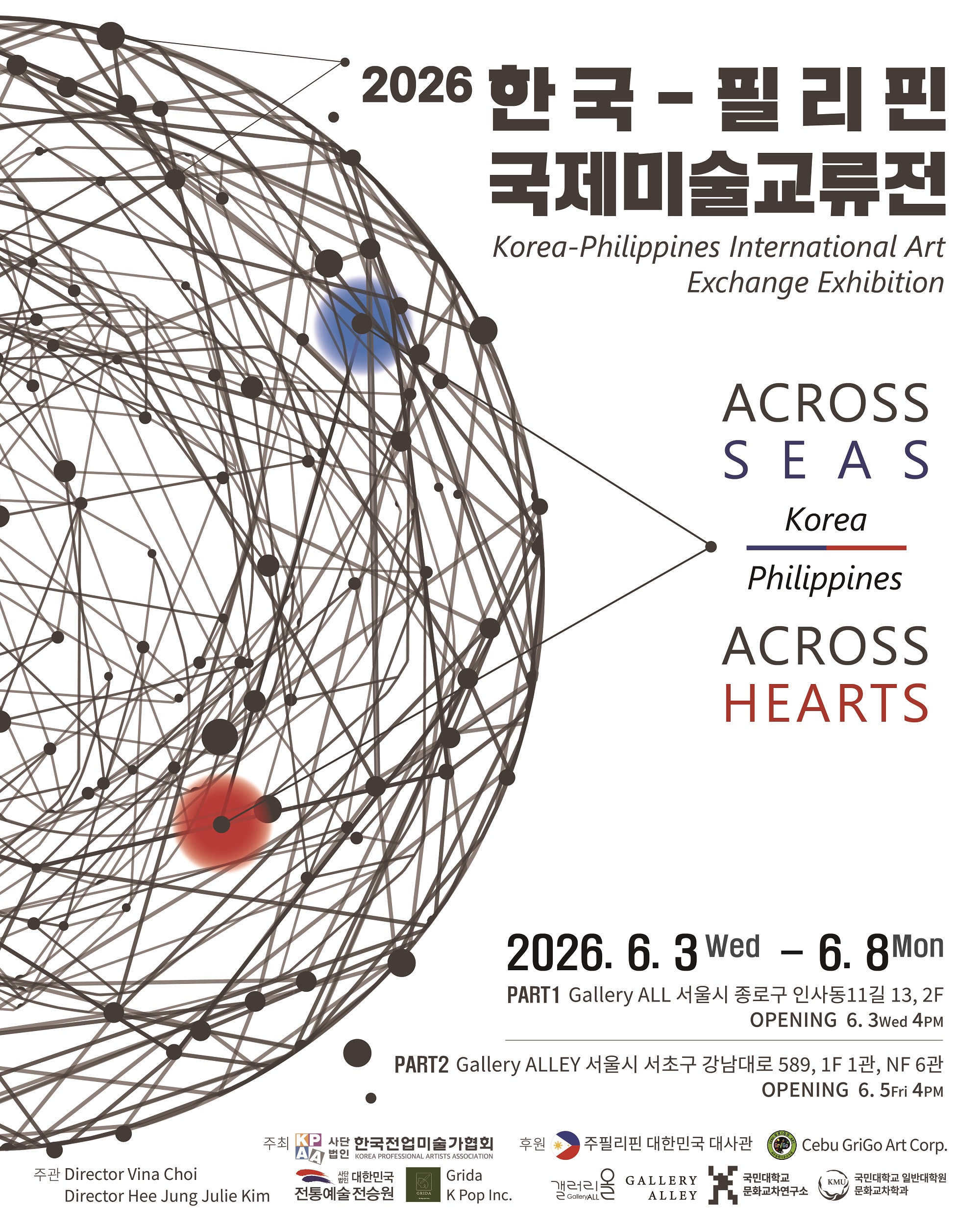
Artists from Korea and the Philippines, bridging differences in language, climate, and history, are set to present a unique art exchange exhibition in Seoul. Titled "2026 Korea-Philippines International Art Exchange Exhibition – Across Seas, Across Hearts," this event transcends a mere showcase of international artists, aiming instead to foster deep resonance amidst their diverse artistic expressions. The exhibition will be held concurrently from June 3 to 8 at two venues: Gallery All and Gallery Alley.
'Across Seas, Across Hearts': Korean and Filipino Art Meets in Seoul
The "2026 Korea-Philippines International Art Exchange Exhibition – Across Seas, Across Hearts" brings together Korean and Filipino artists for a unified showcase in the heart of Seoul. Running from Wednesday, June 3, to Monday, June 8, the exhibition will be presented in two parts: Part 1 at Gallery All in Insa-dong, Jongno-gu, Seoul, and Part 2 at Gallery Alley on Gangnam-daero, Seocho-gu. The opening ceremony for Gallery All is scheduled for 4:00 PM on June 3, followed by Gallery Alley's opening at 4:00 PM on June 5.
The exhibition's core philosophy lies in presenting diverse perspectives side-by-side to discover profound resonance between them. It is hosted by the Korea Traditional Arts & Culture Association, the Korean Fine Arts Association, and Grida K Pop Inc., with co-directors Choi Bina and Kim Heejung overseeing the curation and organization. Adding significant depth to the event, participants include the Embassy of the Republic of Korea in the Philippines, Cebu GriGo Art Corp., Kookmin University Graduate School's Department of Cultural Intersections, and Kookmin University's Institute of Cultural Intersection.
Finding Harmony in Diversity: Directors' Perspectives
Director Choi Bina traces the exhibition's origin to the question, "Are we truly that different?" She emphasizes that exchange isn't about becoming identical, but rather "listening together to the vibrating echoes when our distinct textures meet." She described the exhibition as a space dedicated to this very resonance. Participating artists, too, opted not to converge on a single theme but instead to present their works, each shaped by individual emotions, memories, and perspectives, side-by-side, thereby exploring harmony within diversity.
Co-director Kim Heejung reflected on the preparation process, noting that despite the challenges, the journey of learning from each other and finding harmony felt like a creative act in itself. She expressed hope that this exhibition would not be a one-off event but rather a meaningful starting point for continuous international art exchange. Park Insuk, director of Gallery All, observed that despite the distinct histories and landscapes of Korea and the Philippines, artistic expression serves as a universal language that dissolves national and linguistic barriers. She added that the artworks resonate with universal human emotions and empathy.
Expanding Cultural Exchange: Visions from Organizers and Academia
Jung Uiyeong, director of Gallery Alley, stated that during a challenging period marked by war and conflict, this exhibition transcends a mere display of artworks. Instead, it serves as a valuable opportunity to deepen the cultural friendship and future-oriented cooperation between the two nations. Kim Muho, Chairman of the Korea Traditional Arts & Culture Association, emphasized that traditional arts are not relics of the past but a living culture connecting the present and future, fostering global communication. He expressed his anticipation that this exchange exhibition would be a time for each country's unique identity and sensibility to harmonize within art, generating new inspiration and possibilities.
Professor Sung Dong-kwon, head of Kookmin University's Department of Cultural Intersections, characterized the exhibition as "a sacred festival where the cultural intersection of emotional science comes alive through art." Citing a passage from Confucius's Analects, he asserted that the essence of cultural exchange lies in encountering others who live differently within the freedom of one's own emotions. He further articulated the spirit of the exhibition: even in moments of incomplete understanding, the desire is not "to get angry, but to meet more, understand more, and love more."