A recent big data analysis reveals a burgeoning trend termed "rediscovery consumption," where consumers are finding new value and meaning in familiar products and experiences rather than constantly seeking out new ones. This phenomenon, spanning content, food, and fashion industries, has been identified as a structural trend by the KPR Insight Institute. Through a deep dive into online big data across four key areas—retro consumption, surging content, personalized recipes, and vintage fashion—the Institute observed a consistent pattern of consumers reinterpreting existing values and imbuing them with fresh significance.
Consumers Drive Rise of 'Rediscovery Consumption' Trend
KPR Insight Institute, a subsidiary of comprehensive communications group KPR, has identified the widespread emergence of "rediscovery consumption" through recent big data analysis. This trend sees consumers finding new meaning in familiar items. The research, which conducted an in-depth analysis of online data across four key domains—retro consumption, surging content, personalized recipes, and vintage fashion—reveals a cross-industry phenomenon where consumers are reinterpreting past content, products, and styles, assigning them new personal value.
While traditionally brands proposed new products and consumers accepted them, consumers are now actively discovering and creating new meanings themselves. This represents a cultural shift beyond mere consumption, significantly impacting brand planning and marketing strategies. KPR Insight Institute defines this change as "rediscovery consumption," analyzing it as a structural trend spanning across all industries.
Retro Consumption Evolves from Aesthetics to Emotion
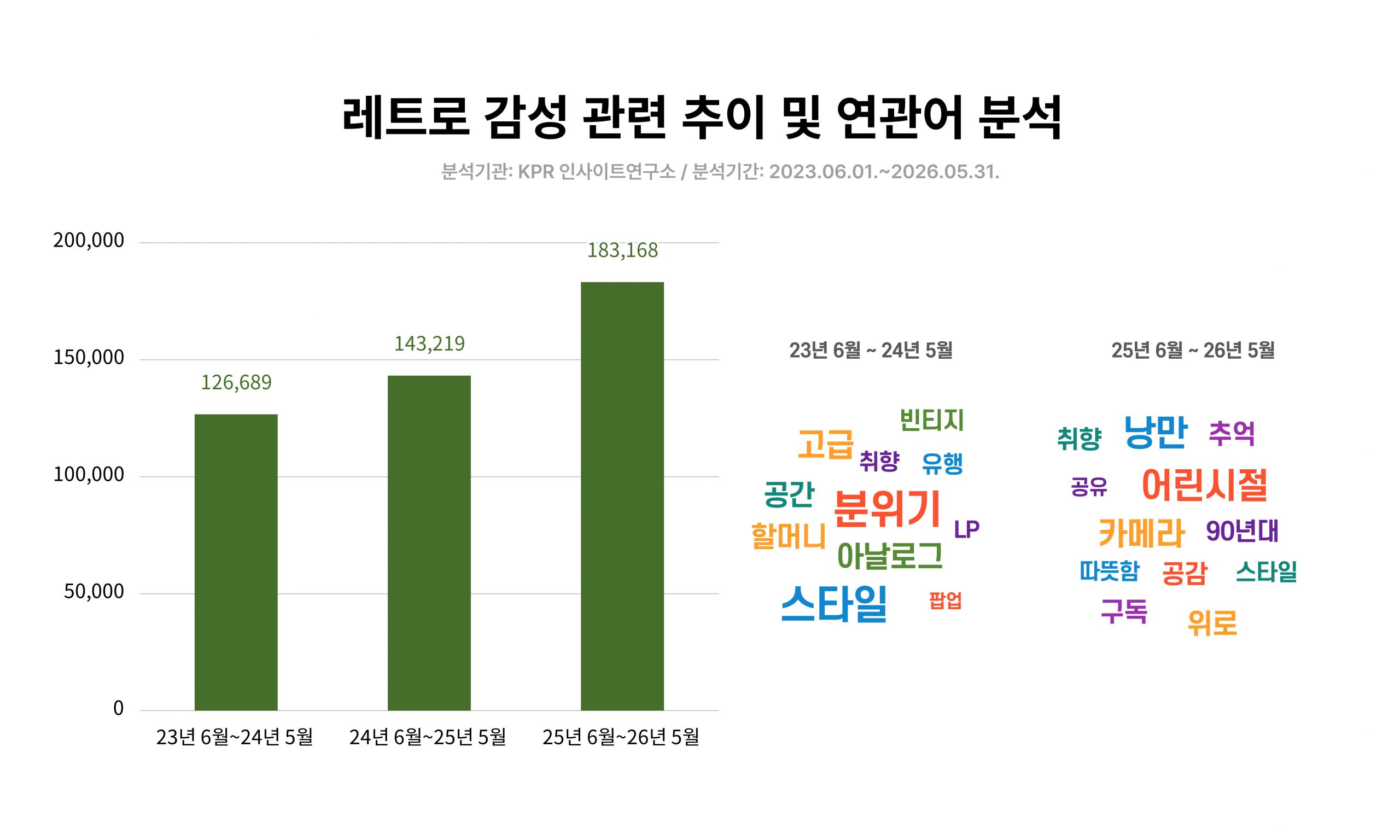
Mentions related to "retro sensibility" surged by approximately 44.6% in just two years, increasing from 126,689 instances between June 2023 and May 2024 to 183,168 instances between June 2025 and May 2026. Alongside this quantitative growth, a qualitative shift in retro consumption is also noteworthy. From 2023 to 2024, keywords predominantly focused on directly recreating past aesthetics and ambiance, such as 'vintage,' 'style,' 'LP,' and 'analog.'
However, in the 2025-2026 period, emotion-centric keywords like 'comfort,' 'empathy,' 'warmth,' 'romance,' and 'childhood' became prominent. This indicates that retro consumption is evolving beyond mere imitation of past styles into "emotional rediscovery consumption," where consumers seek to re-experience past nostalgia and feelings within a contemporary context. Consumers are finding psychological stability and warm connections in familiar things, reinterpreting past memories into their current lives.
Consumer Participation Reshapes Food Market and Brand Strategy
The "rediscovery consumption" phenomenon, driven by consumers, is also notably evident in the food market. Mentions related to "my own recipe" increased by 19% year-over-year to 119,270 instances, with keywords such as 'discovery,' 'challenge,' 'know-how,' 'sharing,' and 'taste' actively emerging. This demonstrates that consumers are moving beyond following conventional recipes provided by manufacturers, instead enjoying the process of creating and sharing their unique combinations and cooking methods, perceiving this as a new consumption experience.
This trend is bringing about innovative changes in brand product planning. There's a growing number of cases where unique combinations and recipes voluntarily created by consumers online lead to the launch of actual new products. The "modisumer" (modify + consumer) culture is firmly establishing itself as a new product planning paradigm in the food market. Shin Myung-hee, Director of KPR Insight Institute, emphasized that "the common thread identified in this analysis is that consumers have become the starting point of rediscovery." She further noted that the industry structure is shifting, with brands now connecting the new meanings assigned by consumers to their products and marketing efforts.
Director Shin also added that, alongside accumulating new assets, strategies to reinterpret existing assets—such as bestsellers, brand heritage, and past campaigns—to align with current consumption contexts are more crucial than ever. This implies that brands must respond flexibly to evolving consumer desires and reposition existing values in novel ways.